
A tyre sidewall is more than a place for a brand name. The letters, numbers and symbols moulded into the rubber tell you whether a tyre fits your wheels, how much weight it can carry, its speed rating and when it was made. Learning how to read a tyre sidewall helps you check a garage’s recommendation rather than accepting a tyre that merely looks similar.
The quickest approach is to decode the large size code, then work around the smaller tyre sidewall markings.
Decode the main tyre size: 205/55 R16 91V
Imagine your car has 205/55 R16 91V printed on its tyre. Those characters describe five specifications. The final letters matter just as much as the first numbers.
205: tyre width
The first number is the nominal section width in millimetres, measured across the sidewalls under specified conditions. Here it is 205 mm, not necessarily the width of the tread touching the road.
55: aspect ratio
The second number expresses sidewall height as a percentage of width. Here, 55% of 205 mm gives a nominal sidewall height of about 113 mm. A lower ratio generally means a shorter sidewall relative to its width, not necessarily a smaller tyre overall.
R: construction
R means radial construction, used by virtually all modern passenger-car tyres. It does not mean radius. Do not substitute a different construction type without vehicle-manufacturer approval.
16: wheel diameter
This is the rim diameter in inches. An R16 tyre fits a 16-inch rim, not a 17-inch one. The number does not give the tyre’s complete outside diameter.
Understand the load index and speed rating
After the size comes the service description. In our example, 91V combines a load index of 91 with a speed symbol of V.
A load index of 91 corresponds to 615 kg per tyre under rated conditions. That does not mean your car can automatically carry four times that amount: axle limits, pressures and manufacturer specifications still apply. V represents a speed category of up to 240 km/h, roughly 149 mph, under specified test conditions. It is not permission to exceed UK speed limits.
Common symbols include T (190 km/h), H (210 km/h), V (240 km/h) and W (270 km/h). The tyre load and speed ratings guide can help explain the differences, but your vehicle handbook or driver’s-door label is the starting point for selecting replacements.
What the smaller sidewall markings mean
XL, Extra Load and Reinforced
XL identifies a tyre designed for greater load capacity than a standard-load equivalent of the same size, at its specified pressure. Reinforced or Extra Load can express the same idea. If your car specifies XL, do not assume the standard-load version is suitable because its dimensions match.
Tubeless, Run Flat and manufacturer codes
Tubeless indicates a tyre intended to hold air without a separate inner tube on a suitable wheel. Run-flat technology may appear as RFT, ZP, SSR or another brand-specific code. Run-flat tyres have vehicle-specific compatibility requirements, so check before mixing types.
Other codes identify original-equipment versions developed for particular car makers. Their basic size may be identical while construction or handling characteristics differ.
Rotation arrows and Outside/Inside
A directional tyre has a rotation arrow showing how it should turn when the car moves forwards. An asymmetric tyre may carry Outside and Inside labels identifying which side faces outwards. A correctly sized tyre can still be incorrectly fitted if these instructions are ignored.
M+S and the snowflake symbol
M+S means Mud and Snow, but the marking alone does not demonstrate performance through a standardised snow test. The three-peak mountain snowflake (3PMSF) symbol indicates a defined snow-grip requirement has been met. This distinction is useful when comparing winter and all-season tyres.
Find the manufacturing date code
Look for a four-digit date code, often at the end of a DOT identification sequence or inside a small moulded panel. For example, 2424 means manufacture in week 24 of 2024. The first pair is the week; the second is the year. The complete code may appear on only one sidewall, so check the inner face if necessary.
Age is one part of condition, not a substitute for inspecting tread, cracks, bulges and damage. There is no blanket UK law requiring every private-car tyre to be replaced on its tenth birthday. Separate restrictions prohibit tyres over ten years old in certain positions on heavy goods vehicles, buses, coaches and minibuses. If an older tyre looks questionable, get a professional inspection.
Approval codes, pressure warnings and wear indicators
An E in a circle followed by numbers identifies a type-approval marking under applicable regulations. It does not establish suitability for every vehicle. DOT identifies compliance with US Department of Transportation marking requirements; its presence does not replace UK fitment checks.
Some sidewalls display a maximum inflation pressure or load statement intended for other markets. Those are not your everyday recommended tyre pressures. Use the vehicle manufacturer’s pressure label or handbook and follow its loaded-vehicle advice.
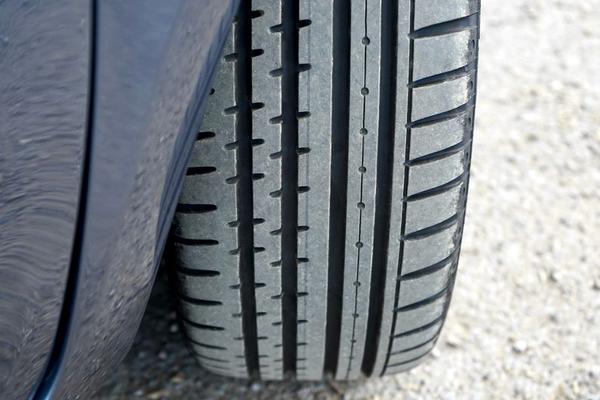
Small TWI letters or triangles point towards tread-wear indicator bars in the grooves. For most UK passenger cars, the legal minimum tread depth is 1.6 mm across the central three-quarters of the tread around its entire circumference. A tread-depth gauge provides a clearer measurement than a glance at the bars.
Check these markings before ordering replacements
Suppose an online listing offers 205/55 R16 87H when your tyre reads 205/55 R16 91V. They appear to be the same size, yet their load and speed descriptions differ. Do not order based on the first three figures alone. Check your vehicle’s permitted specification, including manufacturer-approved alternatives, before buying.
Photograph the full sidewall, check the opposite axle and compare the codes with the handbook. A tyre size guide can explain dimensional alternatives, while a tyre age guide can help with date codes. If a marking is unreadable, ask a reputable tyre fitter to identify it.
Frequently asked questions
Does R16 mean the tyre is 16 inches tall?
No. It means the tyre fits a wheel with a 16-inch rim diameter. Overall tyre diameter also depends on width and aspect ratio.
Where is the tyre’s age printed?
Find the four-digit week-and-year code on the sidewall, often within the DOT identification area. You may need to inspect the inward-facing side.
Can I fit a tyre with a different speed rating?
Only use a rating permitted by the manufacturer’s specification and applicable rules. Some approved winter-tyre arrangements differ, so ask a qualified fitter rather than guessing.
Are M+S and 3PMSF the same marking?
No. M+S is a mud-and-snow designation; 3PMSF means the tyre has passed a defined snow-performance test.
The takeaway
To read a tyre sidewall confidently, work from size to load and speed codes, then check the date, seasonal symbols, approval marks and fitting instructions. This turns a crowded strip of rubber into a practical checklist for buying the correct tyres and spotting problems.